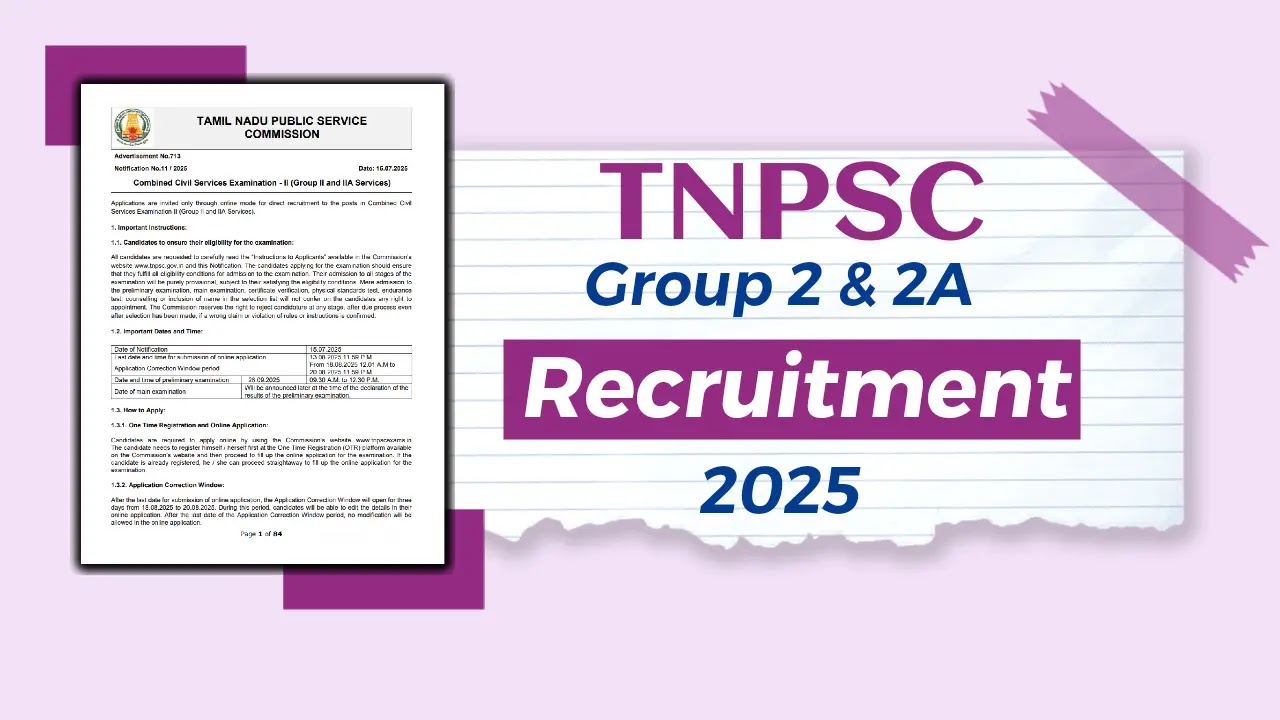
TNPSC Group 2 and 2A Services Recruitment 2025: Tamil Nadu Public Service Commission invites online applications for Combined Civil Services Examination-II (Group II and IIA Services). There are a total of 645 posts. Various posts are available under Group 2 and Group 2A, such as Assistant Inspector, Junior Employment Officer, Assistant Section Officer, Senior Inspector, Audit Inspector, etc. Candidates with a bachelor's degree are eligible for most of the posts. For some posts, an MA in Social Work, a diploma in Social Service, a BSc, or an engineering degree is required. Eligible candidates can apply for it from 15th July to 13th August 2025. The preliminary exam is expected to be held on 28th September. Candidates will get all the important information in this single article. Therefore, they must read the full article before applying for this post.
TNPSC Group 2 and 2A Services Recruitment 2025
Quick Summary
| Job Title | TNPSC Group 2 and 2A Services Recruitment |
| Total Vacancy | 645 |
| Application Dates | 15.07.2025 to 13.08.2025 |
| Official Website | www.tnpscexams.in |
A Deeper Look at the Role
The Combined Civil Services Examination-II offers diverse career opportunities across various departments of the Tamil Nadu government. Selected candidates will work in administrative, ministerial, inspection, and supervisory roles depending on the specific post. These positions offer job security, opportunities for career progression, and the chance to contribute to public service. The work environment varies by department but generally involves office-based work with some field duties for certain positions like Forester or Revenue Inspector. These roles require a combination of administrative skills, subject knowledge, and the ability to work within government systems and procedures.
Career Path and Salary
Selected candidates will be placed in different pay levels ranging from Level 9 to Level 18 in the pay matrix, with corresponding salary structures. The career progression follows the Tamil Nadu government service rules with opportunities for promotion based on seniority and performance. Benefits include pension under the Contributory Pension Scheme (CPS) or Employees' Provident Fund (EPF) depending on the post, medical benefits, and other government employee allowances. The starting basic pay for these positions ranges from approximately ₹35,400 to ₹56,100 per month at the entry level, with additional allowances as per government norms.
Important Dates for TNPSC Recruitment
As we know, TNPSC has released a notification for the recruitment of Group 2 and 2A services. However, all the important dates of this recruitment are mentioned in the official notification, such as application starting and ending dates, preliminary exam dates, etc. But the main exam date is not mentioned in the official notification; therefore, candidates are advised to check the official website regularly for further updates. Important dates are
| Event | Date |
|---|---|
| Notification Release Date | 15 July 2025 |
| Application Start Date | 15 July 2025 |
| Last Date to Apply | 13 August 2025 (11:59 PM) |
| Application Correction Window | 18 August 2025 to 20.08.2025 |
| Preliminary Exam Date | 28 September 2025 (9:30 AM to 12:30 PM) |
| Main Exam Date | Will be announced later |
TNPSC Vacancy Details
As we mentioned earlier, there are a total of 645 vacancies in this recruitment in both Group 2 and 2A services. We have provided the total number of vacancies in both the services below. However, for more detailed information, such as post-wise vacancy details, candidates are advised to read the official notification properly.
| Service | Total Vacancies |
|---|---|
| Group II Services | 50 |
| Group IIA Services | 595 |
| Total | 645 |
Eligibility Criteria
Age Limit (as on 01.07.2025)
For TNPSC Group 2 and 2A Services Recruitment, the age limits vary according to the posts. Therefore, it is advisable for all candidates to check the post-wise age limits in the detailed official notification. However, in general, the minimum age is 18 years and the maximum age is 42 years. Age relaxation for SC/SC(A)/ST/MBC/DC/BC(OBCM)/BCM candidates will be available as per government norms.
Educational Qualification
For most posts: A degree from any University recognized by the University Grants Commission
Specific qualifications: Some posts require additional qualifications like MA in Social Work, Diploma in Social Service, BL degree, etc.
Forester posts: Bachelor's Degree in Science or Engineering in specified subjects
Application Fee
If you talk about the application fees for this recruitment, then we can say candidates have to pay fees for both the preliminary and main examinations. However, SC/ST/Destitute Widow/PwD candidates are exempted from this application fee. We have provided all the details below; candidates are advised to check all the details properly.
| Category | Preliminary Exam | Main Exam |
|---|---|---|
| General/OBC | ₹100 | ₹150 |
| SC/ST/Destitute Widow/PwD | Exempted | Exempted |
TNPSC Selection Process
Candidates who are eligible for this recruitment have to go through the TNPSC selection process. The selection process consists of three stages, which we have described below. However, physical standards are also required for the Forester post only. In the preliminary exam, candidates will face objective-type questions, and it is qualifying in nature. Candidates who clear the preliminary exam will be called for the main examination. Marks obtained in the preliminary exam will not be counted in the final merit list. We have also provided the exam pattern for both the preliminary and mains examinations in this article. Candidates are advised to check it carefully.
- Preliminary Examination (Screening Test)
- Main Examination (Separate for Group II and IIA Services)
- Certificate Verification
- Physical Standards Test & Endurance Test (for Forester posts only)
- Counselling
Exam Preparation Strategy
Clear, focused, and consistent preparation wins TNPSC Group II & 2A. Focus on the syllabus (General Studies, Aptitude/Mental Ability, General Tamil/English and state-specific topics), build a strong foundation with NCERTs, practise previous-year papers + timed mocks, and track weak topics with a strict revision plan.
Daily routine (sample — 12-hour format)
06:00 AM – 07:00 AM: Wake up, light exercise, 20–30 minutes reading (current affairs headlines + Tamil/English editorial summary).
07:30 AM – 09:30 AM: Study slot 1 — Core theory (History / Polity / Geography) — high-focus reading from NCERTs or standard books.
10:00 AM – 12:00 PM: Study slot 2 — Optional/State-specific subject (Tamil Nadu history, economy, polity; or General Science).
12:00 PM – 01:00 PM: Lunch + short break.
01:00 PM – 02:00 PM: Quick revision of morning topics (notes + 10–15 flashcards).
02:00 PM – 04:00 PM: Practice slot — aptitude/mental ability and previous-year objective questions.
04:00 PM – 05:00 PM: Tea break + light reading (magazine/current affairs summary).
05:00 PM – 07:00 PM: Mock test / sectional test (on alternate days) or focused topic practice (on other days).
07:30 PM – 08:30 PM: Dinner + unplug.
08:30 PM – 09:30 PM: Revision (flashcards, one-page notes) and plan next day.
09:30 PM – 10:30 PM: Light reading in Tamil/English (essay, grammar, comprehension practice) or relaxation and sleep preparation.
Weekly routine (sample)
Mon–Fri: Follow the daily routine focusing on syllabus coverage; alternate heavy theory days with practice days.
Saturday: Full-length timed mock test (simulate exam conditions). After the test, spend 1–2 hours analyzing mistakes.
Sunday: Consolidation + weak-topic revision + current affairs weekly summary + practice of Tamil/English comprehension and grammar. Light relaxation in evening.
Every 3rd week: Replace one mock with a thorough revision day for all short notes and error log.
Best books & resources (subject-wise)
Core foundation (all subjects): NCERT books (Class 6–12) — must-read for basics in History, Geography, Economics and Science.
Indian Polity: M. Laxmikanth — Indian Polity (concise reading + make one-page notes of fundamentals and amendments).
Modern & Ancient History: Shortlisted Modern India chapters from NCERTs (Class 11/12) and one concise modern India book (e.g., Bipan Chandra / Spectrum Modern India) for depth. For Tamil Nadu history, use TN state board history textbooks and a TNPSC-focused guide (previous-year solutions/compiled notes).
Geography: NCERTs (6–12) + Certificate Physical and Human Geography (G.C. Leong) for basics + Oxford School/Any good Atlas for maps.
Economy: NCERTs, plus a simple primer on Indian economy (Ramesh Singh or short TNPSC economy notes). Focus on basics + current economic indicators.
Science & Environment: NCERT Science 6–10 and selective Class 11/12 chapters; environment topic notes (biodiversity, pollution, policies).
Mental Ability / Aptitude: R.S. Aggarwal (Quant & Reasoning) or any standard aptitude book; practice TNPSC-format objective questions.
General English / Tamil: State board grammar books, one good Tamil grammar guide, comprehension practice, short essay & precis books for practice.
Current Affairs: Daily newspaper (The Hindu / Indian Express) — focus on national/state news, editorials; monthly current affairs compilations and TNPSC current affairs summaries.
Must-have for practice: TNPSC previous years’ question papers & a reliable question bank / mock-test series tailored to Group II & 2A.
How to give mock tests (practical plan)
Start with sectional mocks: When syllabus coverage is ~40–60%, take sectional/micro-tests (30–60 mins) to build accuracy and speed in each area.
Full-length mocks: After covering most syllabus, take a full-length timed mock every week (6–8 weeks before exam) and then increase to 2 per week in last 4 weeks.
Simulate exam conditions: Silence, no phone, strict time limits, use only permitted items (calculator only if allowed in actual exam). This trains concentration and stamina.
Mix sources: Use mocks from coaching institutes, online platforms, and previous-year sets to avoid pattern bias.
Mock test analysis — step-by-step
Immediate post-test (within 1 hour): Mark which questions you got right, guessed, or got wrong. Don’t jump to solutions yet; first record time spent per section and question types that consumed time.
Error classification: Create an error log with categories: Conceptual gap, careless mistake, calculation/time pressure, lack of facts (e.g., dates/facts), and reading-misinterpretation.
Root cause + Fix: For each error, write one-line root cause and one-line fix (e.g., "Misread question — practice selective reading drills; underline keywords").
Topic drill: For repeated weak topics, do concentrated drills (20–40 questions) until you reach 80–90% accuracy in that topic.
Weekly review: Go through the error log weekly and reduce recurring errors; track progress as % reduction in same-category errors.
Time-management strategies for the exam hall
First pass / second pass: Do a quick first pass answering easy, high-confidence questions (30–40 minutes). Mark doubtful ones and attempt harder ones on the second pass.
Time allocation: Divide total time proportionally to marks/sections. Keep 10–15 minutes at the end for review and to attempt any marked questions you can answer faster the second time.
Don’t get stuck: If a question takes >1.5–2 minutes, mark and move on. Returning later with a fresher perspective often helps.
Guessing strategy: Know the negative marking rule for the specific exam year. If negative marking exists, attempt only when elimination gives >50% confidence.
Note-making & revision plan
One-page notes: After finishing each major topic, make a one-page summary. These are golden in the last 20–30 days.
Flashcards: Use flashcards for dates, acts, schemes, important map facts, and vocabulary (Tamil/English).
Revision cadence: 1st revision within 48 hours of studying, 2nd revision in 7 days, 3rd revision in 30 days. Use spaced repetition for maximum retention.
Focus on State-specific (Tamil Nadu) topics
Give special attention to Tamil Nadu history, geography, administration, welfare schemes, state economy, and recent state government policies — use TN state board textbooks and TNPSC compilations.
Learn major district facts and map points; practise state-level current affairs (state budget, prominent schemes, legal/administrative changes).
Motivation, health & exam mindset
Sleep 7–8 hours — stamina matters. Light exercise or short walk daily to keep energy and concentration high.
Keep social media/phone usage limited during study hours. Use app timers if needed.
Set short, measurable weekly goals (e.g., finish Mains Civics topics + 3 full mocks). Reward small wins to prevent burnout.
Quick checklist before the exam
Finish a 2–3 hour final revision of one-page notes and flashcards the day before (no new topics).
Pack necessary documents, admit card, ID, pens, watch (if allowed), and reach center early.
Calm breathing/short meditation before entering exam hall to settle nerves.
Final tips
Consistency > intensity. Even 6–8 well-structured hours daily over months beats chaotic cramming.
Quality mocks + disciplined error analysis accelerates improvement — treat each mock as a learning tool, not just scoring.
Keep revising Tamil/English language skills — these fetch easy marks if practised regularly.
Maintain an error log and one-page notes — they become your exam survival kit in the last 3–4 weeks.
TNPSC Group 2 and 2A Services Exam Pattern
Candidates who are eligible for this recruitment have to go through the TNPSC selection process. The selection process consists of three stages, which we have described below. In the preliminary exam, candidates will face objective-type questions, and it is qualifying in nature. Candidates who clear the preliminary exam will be called for the main examination. Marks obtained in the preliminary exam will not be counted in the final merit list. We have also provided the exam pattern for both the preliminary and mains examinations in this article. Candidates are advised to check it carefully.
TNPSC Preliminary Examination
In the preliminary examination, a candidate will get 3 hours to answer 200 questions. The total marks of the examination are 300. There are three sections in this preliminary examination, which are given below in a table format for the easy understanding of the candidates.
| Subject | Questions | Marks | Duration |
|---|---|---|---|
| General Tamil/General English | 100 | 150 | 3 hours |
| General Studies | 75 | 112.5 | |
| Aptitude and Mental Ability | 25 | 37.5 | |
| Total | 200 | 300 |
TNPSC Main Examination (Group II Services)
| Paper | Subject | Marks | Duration |
|---|---|---|---|
| Paper I | Tamil Eligibility Test (Qualifying) | 100 | 3 hours |
| Paper II | General Studies | 300 | 3 hours |
TNPSC Main Examination (Group IIA Services)
| Paper | Subject | Questions | Marks | Duration |
|---|---|---|---|---|
| Paper I | Tamil Eligibility Test (Qualifying) | - | 100 | 3 hours |
| Paper II | General Studies (150) General Intelligence & Reasoning (50) | 200 | 300 | 3 hours |
Physical Standards (For Forester Posts)
Physical standards are required for Forester posts as mentioned in the official notification, such as height and chest expansion. We have provided all the details below for both male and female candidates. Therefore, interested candidates must check whether they are eligible for it or not.
| Category | Height (cm) | Chest Measurement (cm) |
|---|---|---|
| Male (Non-ST) | 163 | 79 (normal) + 5 (expansion) |
| Male (ST) | 152 | 79 (normal) + 5 (expansion) |
| Female/Third Gender | 150 | 74 (normal) + 5 (expansion) |
How to Apply for TNPSC Group 2 and 2A Services
Eligible candidates can apply for this recruitment through its official website. We have provided all the steps below on how to apply for it. Candidates are advised to enter all the details correctly while filling out the application form. After submitting the application form, candidates must take a printout of the application form for future reference.
- Register through One Time Registration (OTR) on TNPSC website (www.tnpscexams.in)
- Pay registration fee of ₹150 (valid for 5 years)
- After registration, fill online application for the examination
- Upload required documents (photo, signature, certificates)
- Pay examination fee (if applicable)
- Submit application before deadline (13.08.2025)
TNPSC Recruitment Important Links
All the important links of this recruitment are given below. Candidates can use these links to visit the official website and download the official notification. However, there is also a link to the direct application portal through which candidates can navigate to the application portal easily.
Additional Details
- Candidates must have adequate knowledge in Tamil
- Banned items in exam hall: Mobile phones, electronic devices, smart watches, books, etc.
- Exam centers available across all districts of Tamil Nadu
- Reservation rules apply as per Government norms
FAQs – TNPSC Group 2 & 2A Services 2025
What is the last date to apply?
The last date to apply online is 13.08.2025 at 11:59 PM.
How many vacancies are there?
Total 595 vacancies (50 in Group II and 545 in Group IIA Services).
What is the selection process?
Preliminary Exam → Main Exam → Certificate Verification → Physical Test (for Forester) → Counselling.
